

On This Day: 16th November 1945 - The Birth of UNESCO
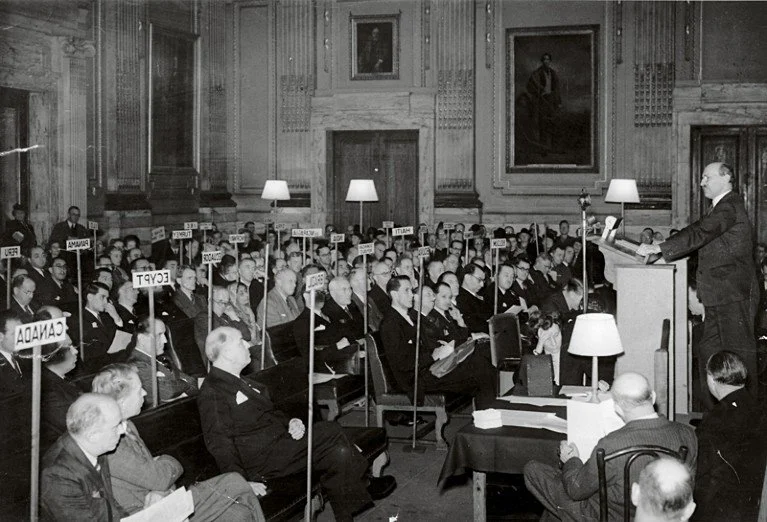
The conference in London in 1945 where fourty-four nations agreed the adoption of UNESCO.
On 16th October 1945, as the ruins of war still marked London’s skyline, representatives of forty-four nations signed a new constitution. Their task was not just to rebuild bridges or ports or industrial plants, that work would come later. Instead, they were asked to rebuild something far less tangible and far more ambitious: the conditions of peace in the minds of people.
So began UNESCO: the United Nations Educational, Scientific and Cultural Organization. It was born of a conviction unusual for the time, and still startling today, that ideas not armies, determine whether societies drift toward cooperation or collapse into conflict; that education and culture are not peripheral to politics, but lie at its deepest core. This was more than a post-war administrative body in that it was an experiment in imagining what humanity might learn from its own brutality.
The Conditions of Its Birth
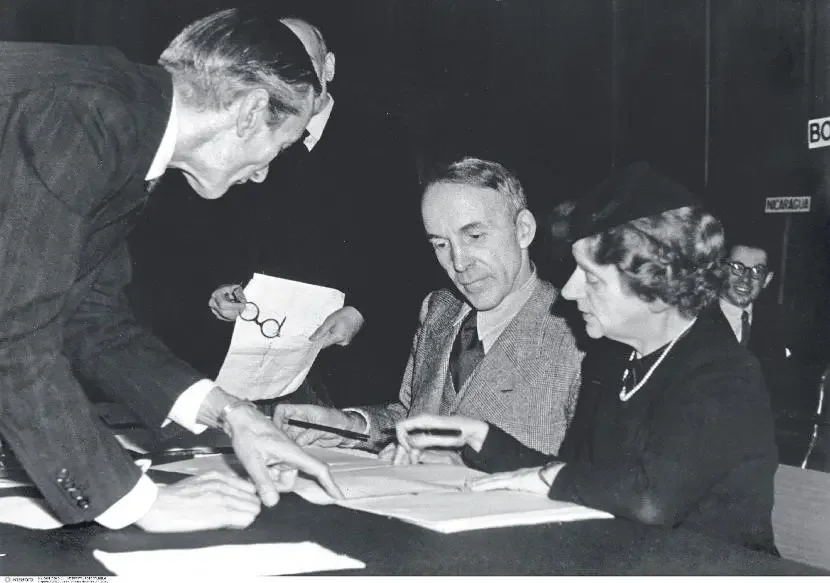
Archibald MacLeish in 1945.
The war had ended only months earlier. Europe’s cities were still smoking, its museums emptied, its universities still suffering from the effects of war. Millions were displaced, traumatised, or illiterate. The memory of Nazi propaganda was painfully fresh. Classrooms had been weaponised and atttempts at rewriting history had left textbooks censored as well as teachers imprisoned or purged. The world understood that the war had been fought as much across continents as it had across curricula and culture.
Into this climate a group of thinkers and diplomats entered who believed that education could no longer be treated as just a domestic matter. If the world was to avoid another catastrophe, “defences of peace” needed to be built in minds rather than in the barricades across borders. The UK convened a meeting in late 1945 and drew delegates from four continents to consider how education and culture might be mobilised to prevent future war. Arguments were fierce: Should UNESCO be a technical body focused on reconstruction, or a philosophical one focused on moral renewal? The final constitution combined both instincts, declaring UNESCO’s purpose to be “the intellectual and moral solidarity of mankind,” a phrase that blended idealism with a recognition of how fragile solidarity had proved.
The Characters Who Shaped It
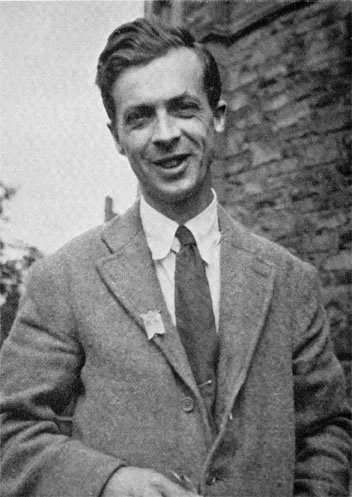
Evolutionary biologist, Julian Huxley.
UNESCO did not arise from anonymous committees but from vivid personalities. Julian Huxley, the British evolutionary biologist appointed the first Director-General, infused the organisation with his humanist vision. Huxley believed that science and education could cultivate a global consciousness capable of resisting authoritarianism. His instincts leaned toward universalism — sometimes controversially — but his energy ensured UNESCO attempted to be more than a clearinghouse of information.
Archibald MacLeish, the American poet and former Librarian of Congress, brought a literary sensibility. It was he who drafted UNESCO’s preamble, deliberately choosing language that read less like a constitution and more like a moral manifesto. MacLeish believed that symbolism mattered as much as policy, that institutions needed ideals to animate them.
René Cassin, the French jurist who would later help craft the Universal Declaration of Human Rights, pushed UNESCO to embed dignity and rights into its educational philosophy. With Cassin’s influence, the organisation became a forum for articulating what education should mean, not merely what it should deliver.
Equally crucial were the delegates from Asia, Africa, and Latin America, including intellectuals from countries soon to emerge from colonial rule. They insisted that “world culture” must not be a euphemism for Western culture. They demanded that literacy campaigns include indigenous languages, that curricula reflect local histories, and that UNESCO assist in the creation of education systems independent of colonial influence. Their presence widened UNESCO’s vision, transforming it from a European recovery project into a genuinely global institution.
Why UNESCO Was Revolutionary
UNESCO’s founding premise was radical: that education, culture, and science shape political reality more deeply than any military alliance. The organisation challenged the assumption that schooling was a neutral domestic service. Instead, it declared that the way nations educated their citizens had global consequences, shaping attitudes toward conflict, democracy, and human rights.
UNESCO also insisted that culture was not a private possession of nations but a shared human inheritance. In a world scarred by the destruction of books, monuments, and languages, this was revolutionary. Likewise, its commitment to scientific cooperation ran counter to the emerging Cold War instinct to hoard scientific knowledge as strategic capital. UNESCO treated science as a bridge rather than a weapon.
But perhaps most revolutionary was the belief that peace could be built deliberately through the curriculum. Literacy, critical thinking, and intercultural understanding were not seen as “social goods” but as building blocks of global security. UNESCO staked its existence on the claim that informed citizens were humanity’s best defence against the recurrence of fascism.
Its Early Work: Rebuilding Minds
UNESCO’s early initiatives combined practical urgency with philosophical ambition. The organisation helped reopen schools across Europe, providing basic materials — paper, textbooks, training programmes — to classrooms devastated by bombing. It played a pivotal role in reshaping Japanese education during the postwar occupation, supporting reforms that emphasised democratic governance and academic freedom.
Simultaneously, UNESCO began sending educational missions to rural communities in Asia, Africa, and Latin America. Its “Fundamental Education” projects aimed to integrate literacy with public health, agriculture, and civic participation. The idea was not that literacy alone would transform societies, but that it would empower citizens to shape their own futures. UNESCO’s early scientific initiatives were similarly ambitious: efforts to compile a global bibliography, organise international scientific unions, and promote open exchange of research across borders. Underlying all these activities was a belief that education could rebuild societies at their foundations.
Achievements Across Eight Decades
Across the decades, UNESCO has produced achievements that have discreetly reshaped global education and culture. One of its most significant legacies is the World Heritage Convention of 1972, which reframed cultural and natural landmarks as part of humanity’s shared identity. The rescue of Abu Simbel in Egypt — a massive, multinational engineering project to protect ancient temples from the rising waters of the Aswan Dam — remains the emblem of what UNESCO can accomplish when nations recognise that heritage transcends sovereignty.
UNESCO has also been a global leader in literacy. Its campaigns in countries such as India, Senegal, and Brazil have helped transform literacy from an individual skill into a civic right, embedding the idea that education is foundational to human development. The designation of International Literacy Day helped situate literacy in global policy discourse.
The organisation’s role in defining education as a human right is equally significant. UNESCO was instrumental in shaping Article 26 of the Universal Declaration of Human Rights, giving moral and legal weight to the principle that all children, regardless of background, deserve access to schooling.
Its work on teacher status has been similarly influential. The 1966 ILO–UNESCO Recommendation established an international benchmark for teacher rights, emphasising that teaching is a profession requiring respect, training, and proper working conditions. Many modern teacher standards trace their lineage to this document.
UNESCO’s scientific achievements are less widely known but equally important. It has helped establish international frameworks for oceanography, astronomy, environmental monitoring, and climate science. Today, it is a leading global authority on digital ethics, providing the first international normative framework for the governance of artificial intelligence in education and beyond.
These achievements show UNESCO’s capacity to turn abstract ideals into concrete global structures.
The Challenges: Lessons in Fragility
UNESCO’s challenges over the years reveal as much about the world as its achievements. The Cold War turned the organisation into an intellectual battleground, with East and West vying to define the meaning of “education for peace.” UNESCO had to walk a tightrope between universalism and ideological neutrality, a balancing act that exposed the vulnerability of global institutions in polarised times.
Decolonisation presented another challenge. UNESCO sought to support newly independent nations in building educational systems, but sometimes inadvertently reproduced colonial biases. This tension illuminated a central dilemma: how can an international body promote shared values without imposing cultural hierarchies?
The repeated withdrawal of the United States- first in 1984 under Reagan, then effectively in 2011 after Palestine’s admission, and again in 2017 under Trump - demonstrated UNESCO’s dependence on political goodwill. These departures disrupted budgets, demoralised staff, and signalled that even education and culture were not immune to geopolitical conflict. When the U.S. rejoined in 2023, it did so partly out of recognition that global standards on AI, digital literacy, and information governance were too important to leave to others.
UNESCO has also faced structural challenges: chronic underfunding, accusations of bureaucracy, and the difficulty of coordinating projects across disparate cultural and political contexts. More recently, the rise of digital misinformation has tested UNESCO’s ability to respond swiftly to rapidly shifting educational landscapes. These challenges reveal not failure, but relevance. Institutions that attempt to shape knowledge inevitably become sites of contestation.
Why UNESCO Matters — Perhaps More Than Ever
UNESCO’s founding insight, that wars begin in the mind, remains strikingly contemporary. Education is increasingly at the centre of cultural battles: debates over history curricula, the politicisation of textbooks, the control of language, the rise of algorithmic bias. The modern world is defined as much by informational conflict as by military conflict.
UNESCO provides a framework for understanding these struggles. Its history shows that education is never neutral; it always reflects choices about identity, power, and memory. UNESCO’s work demonstrates that cooperation is fragile but necessary, and that the protection of cultural heritage is inseparable from the protection of human dignity. In its ongoing efforts to develop ethical guidelines for AI, UNESCO shows that the future of learning cannot be left to market forces or national politics alone.
Most of all, UNESCO matters because it is one of the few institutions explicitly designed to protect the intellectual commons of humanity; the shared domain of ideas, histories, and cultures through which we understand ourselves and one another. As global politics fractures and nationalism resurges, UNESCO’s existence poses an important: question: Do we still believe in learning as a force for peace?
Marking the date of UNESCO’s founding is not just nostalgic reflection upon a brief moment of moral and purposive clarity. It is a recognition that education, culture, and science shape the world more deeply than any treaty or economic pact. UNESCO came into being because nations understood that peace required shared knowledge and collective responsibility. Today, as misinformation spreads and ideological conflict hardens, its founding principle feels less utopian and more essential.
Wars still begin in the minds of people. And it is still there; in classrooms, in language, and in cultural memory, that the defence of peace must be built.
